This article explains several features that enhance user collaboration and administrative control within Presentations.
Top menu bar
The top menu bar offers the following options:
Rename. It allows the Administrator to rename the selected Presentation. This action is also available from the context menu within the Presentations grid.
Open. It opens the selected Presentation.
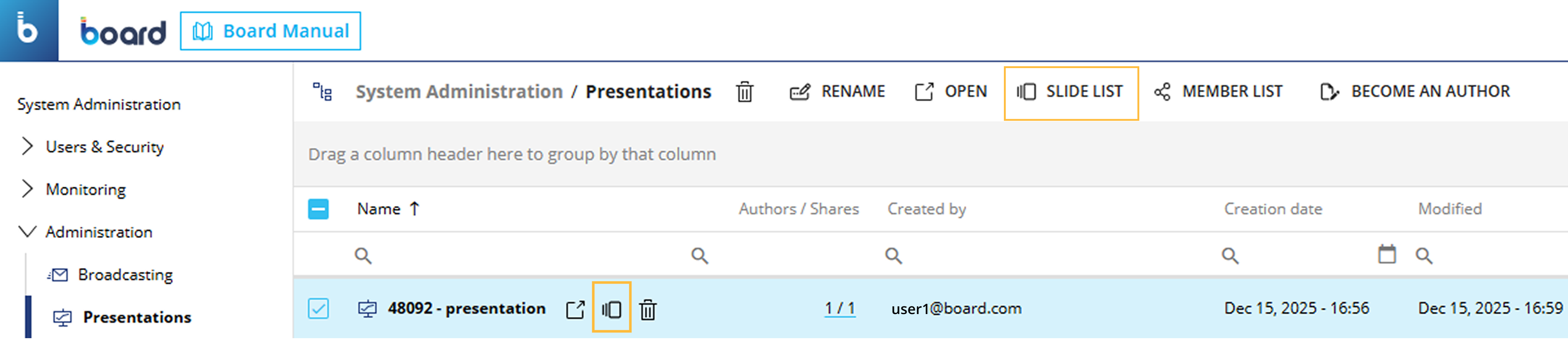
Slide List. It displays a list of all Slides within the Presentation.
Member List. It displays all users associated with the Presentation. The list includes details such as the author’s last access date and last edit date, and indicates if the user is the author of the Presentation. A context menu is available in the Member List grid, providing quick access to actions such as Email, Chat, and Add/Remove Permits. The Member List option shares some behaviors with standard table grids, which allow users to reorder columns and perform searches. However, the option does not fully inherit all table grid functionalities, as grouping options are not available with the Member List option.
Become an Author. It allows the Administrator to take ownership of a Presentation as an author. This option is also accessible from the context menu in the Presentations grid.
Both the System Administration for Presentations and Member List grids now include context menus that replicate the functionality of the toolbar, which allows Administrators to perform key actions directly from the grid.
.png)
The System Administration for Presentations grid also displays information that indicates the total number of Presentations and how many are currently selected. This behavior is consistent with other grids in the platform, such as those in the Send To and Subscriptions features.
.png)
Chat, Email, and Delete
Three icons—Chat, Email, and Delete—are available in the top menu bar of the Member List feature.

.png)
The same three icons are also displayed when hovering over an author’s email address inside the Member List feature.
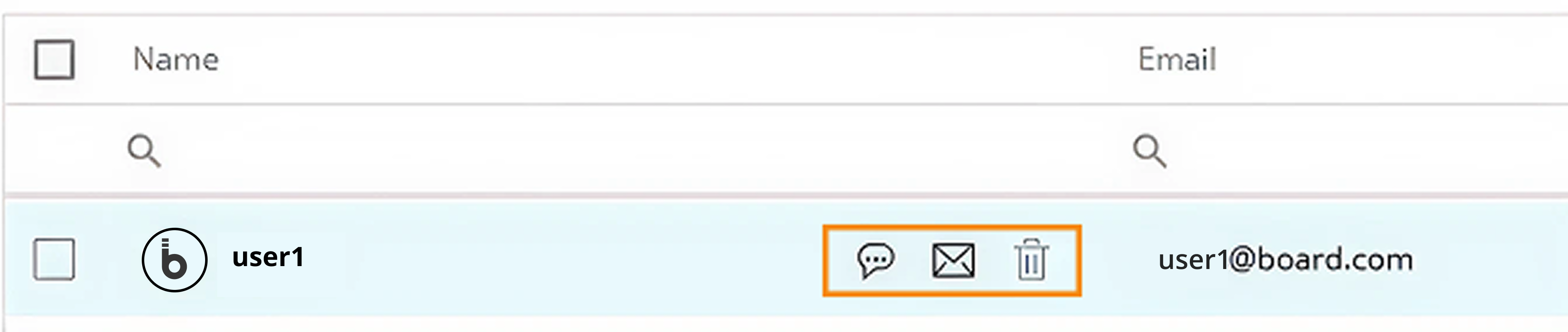
Chat. The Chat feature allows the Administrator to communicate with users in the sharing list of a Presentation by creating either a single chat or a group chat. The chat window opens on the right side of the screen and remains visible while the Presentation is open.
Email. The Email feature enables Administrators to send an email to one or more users included in the sharing list of a Presentation. When this action is selected, the system opens the user's default email and automatically pre-fills key fields:
Recipients. The email addresses of the selected users.
Subject. The Presentation’s name.
Body. A message containing a direct link to the Presentation.
Delete. The Delete feature allows an author or Administrator to remove a selected user from the Presentation’s member list, thereby revoking that user’s access to the Presentation.
Presentations must have a user with author permissions
In a Presentation, at least one user must have author permissions. This rule applies to both user removal and author permission management: it is not possible to remove all users from a Presentation or revoke author access from the last remaining author.
Slide List
This panel displays a sequential list of the Slides in this Presentation.
If a user does not have either view or edit access to the Presentation, it is not possible to view the Slides. For more information about Slides, see Create a Slide.
The Slide List can be accessed through:
The top menu in the Presentations grid.
The Slide List icon that appears when hovering over a Presentation name
 .
.
By right-clicking the selected Presentation to open the context menu.
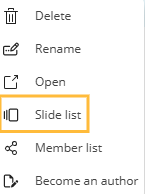
The Slide List opens in a dedicated modal window, which presents metadata such as the Slide's associated custom object or custom filter, the Slide's position and order within the Presentation, and navigation buttons that allow users to jump directly to a selected Slide. The Slide List modal inherits standard table grid behavior, including column management, ordering, and search capabilities.
This feature helps users manage, review, and navigate Presentation content efficiently.

Hover over a screen in the Slide List (e.g., Screen 4) and click on the icon that appears  to view the associated Screen Capsule in a new browser tab.
Click on the Column Chooser icon  on the right to add the Last modified by column. This column displays the name of the user who most recently edited the Slide List.

.png)
Become an Author
The Become an Author feature allows an Administrator to take ownership of a Presentation by assigning author permissions to themselves. This action enables the Administrator to directly manage and edit the Presentation content, rather than only administering access or settings.
The option is available from the Presentations interface and can be accessed through:
The top menu in the Presentations grid.
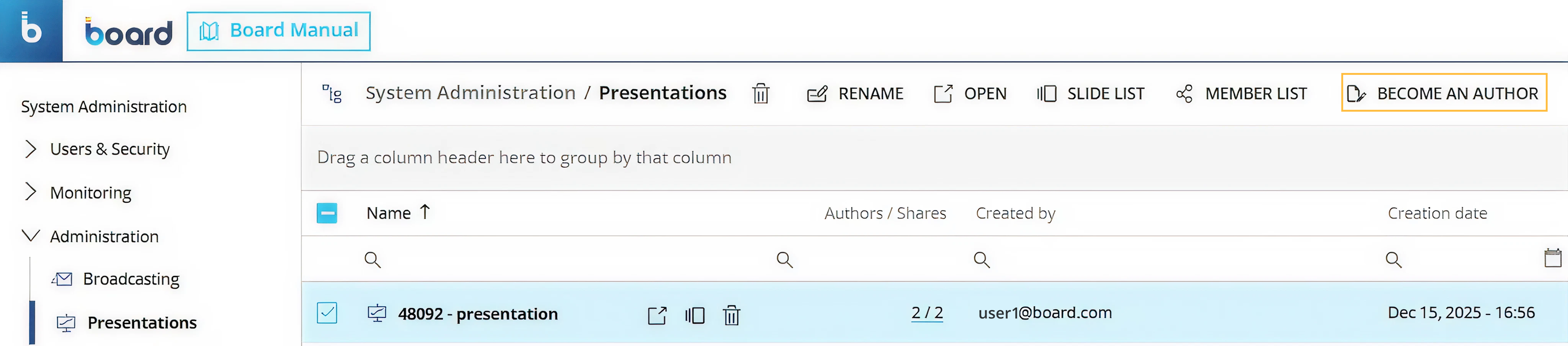
By right-clicking the selected Presentation to open the context menu.
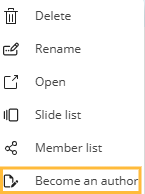
When the Administrator selects Become an Author, author permissions are immediately assigned to the logged-in Administrator user in addition to their administrative rights. A confirmation pop-up message appears stating "Successfully became author of selected presentations", indicating that the action has been completed successfully. The user joins any existing authors who already have access to modify the selected Presentations.
Once the Administrator becomes an author, they gain full authoring capabilities for the selected Presentation, including content modification and collaboration management. This is particularly useful when a Presentation requires maintenance, updates, or reassignment, and no active author is available.
A Presentation must always have at least one author. The Become an Author action ensures continuity of ownership and guarantees that author-level access is maintained for governance and content management purposes.
Author access management
Author access is managed through the Add Author Access and Remove Author Access actions, available in the top bar of the Member List, alongside the Email and Chat features. These actions are only available to users with author permissions, ensuring that control over collaboration settings remains restricted to authorized contributors.
To access these options, authors must first open the Member List of the Presentation.
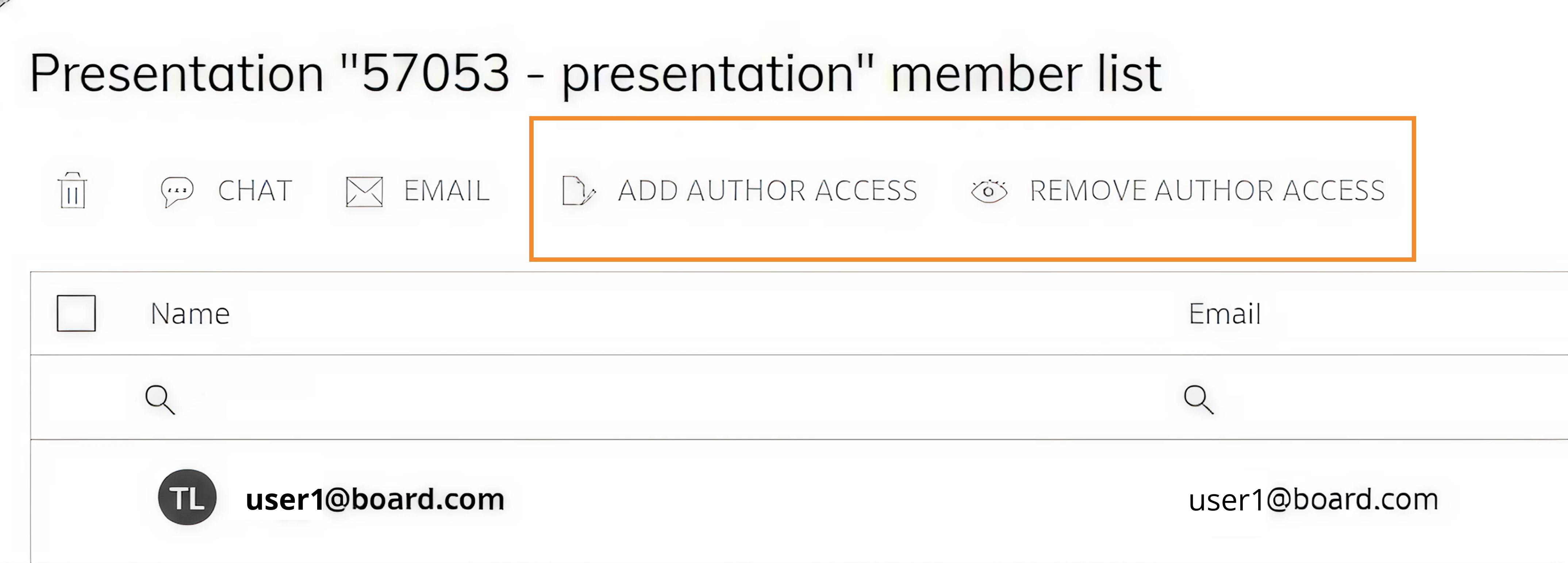
These actions allow authors to grant or revoke authoring permissions for users included in the Presentation's sharing list. This enables controlled collaboration while maintaining governance over content modifications.
A Presentation must always have at least one user with author permissions. For this reason, it is not possible to remove all users from a Presentation or revoke author access from the last remaining author.